Communication & Play

Communication and play in babies and toddlers

Learning to share their world

Your baby makes a sound, then waits for yours. Your toddler points insistently at a dog across the street. A stuffed animal gets offered a spoonful of imaginary lunch.

Your child is finding ways to connect with you, tell you something, and make sense of what happens around them.

Flourish helps you recognize those emerging abilities, find your child’s starting point, and choose practical activities across all five development areas.

Communication & Play includes how your child understands and expresses ideas, shares attention, copies actions, and explores through play. Sounds, gestures, words, and make-believe all give you something to notice and build on together.

What is your child showing you?

First words are exciting. So are the exchanges that happen around them: bringing you something interesting, joining in a familiar game, or understanding what you mean when you say it’s time for shoes.

Making sounds back when you talk
Taking part in a back-and-forth exchange
Pointing, reaching, or showing you something
Communicating an interest or intention
Looking toward something you point out
Sharing attention with another person
Copying a clap, wave, or familiar action
Learning by watching and joining in
Responding to a familiar phrase or simple direction
Understanding language
Using sounds, words, or short phrases
Expressing ideas in increasingly specific ways
Feeding a toy or acting out a familiar routine
Using pretend play to explore experiences and ideas

These are useful things to watch during ordinary life. You might notice your child bringing a shoe when you mention going outside, or handing you a toy because they want the game to happen again.

Recognizing the invitation gives you somewhere to begin.

Four ways to connect through play

These examples come from activities in Flourish. Choose something your child is interested in and able to join. For any toys or props, follow their age guidance and keep small parts out of play for children under three.

Leave room for their reply

When your baby is calm and alert, hold them comfortably with their head and neck supported. Talk softly, smile, and pause.

Notice what comes back. A sound, a change in expression, or a movement can give you something to respond to. You can copy a sound they make and leave another opening.

You don’t need a constant stream of conversation. A few exchanges can be the whole activity.

If there’s a lot happening around you, try somewhere quieter. Follow your baby’s cues about whether they want to keep engaging or have had enough.

From Flourish: Face-to-Face Soft Talk.

Bring back a familiar hand game

Sit facing your child and try a simple clap or wave. Give them time to watch, then repeat it.

A familiar song such as pat-a-cake gives the game a rhythm. Your child might copy an action, make a sound, smile, or simply watch closely before joining another time.

Keep the action manageable. One clap can be enough to start with. As the game becomes familiar, you can add another action or let your child choose what happens next.

There’s no need to move their hands for them. Show them, wait, and respond to the part they’re interested in.

From Flourish: Simple Hand Games.

Let the animals do some talking

Open a book with familiar animals or gather a few large, age-appropriate animal toys.

Pick one that catches your child’s interest. “A cow. Moo!” Then give them a turn.

They might copy the sound, point to another animal, or hand you the same one for another performance. Follow that response. You can name the animal again or add a short phrase: “The cow is eating.”

Start with a few familiar animals. You can return to the same ones as often as your child enjoys them. You don’t need to work through every animal in the book.

From Flourish: Animal Sound Safari.

Give a favorite toy a part to play

Put a few suitable toys in a box and begin a simple story with one of them.

Perhaps a teddy is hungry. Offer a pretend spoonful, then let your child decide what happens. They might feed teddy again, put him to bed, or bring another toy into the game.

If they’re beginning to explore pretend play, one familiar action is enough. If they already enjoy making up stories, follow their ideas and add a character or another event.

The box gives you a place to start. Your child supplies plenty of possibilities.

From Flourish: Story Box Adventure.

Make it a conversation you both contribute to

It’s easy to fall into asking questions when you’re trying to help a child learn. What’s that? What color is it? What does it say?

There’s also value in commenting on what has their attention and giving them room to respond.

If they point at a passing truck, you can say, “A truck! It’s loud.” If they say “dog,” you might add, “Yes, a big dog.” You’re giving them words connected to something they already care about.

During play, watch for their ideas as well as their answers. A child who hands you a cup may be asking you to join their pretend picnic. Accept the cup. See where the game goes.

These responsive exchanges give your child opportunities to participate, hear language, and influence what happens next.

Where is your child starting?

Communication includes several abilities that don’t all develop in exactly the same way.

Your child may understand familiar routines, use plenty of gestures, and be beginning to try words. They may enjoy copying you while still figuring out how to build a pretend game.

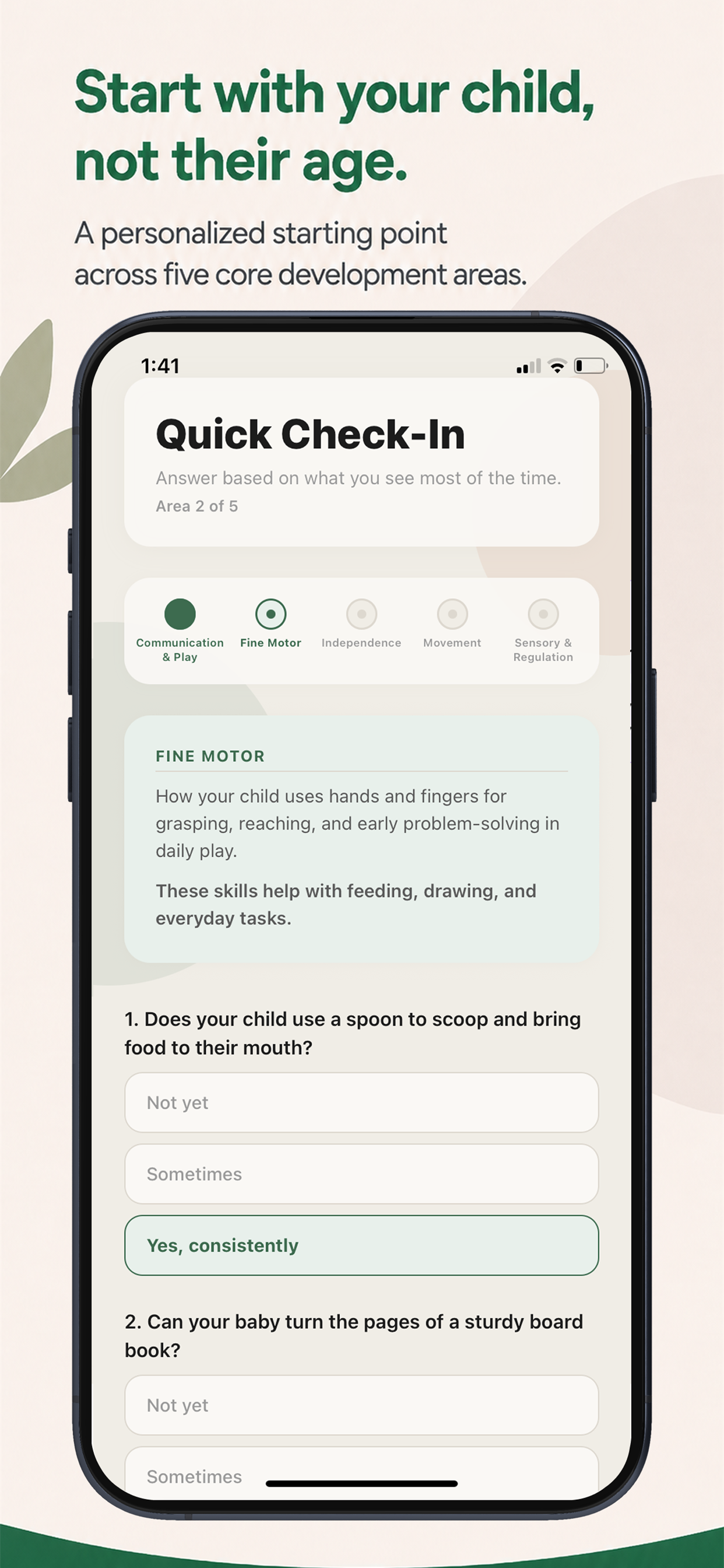
Flourish’s onboarding check-in asks about things you can observe, including how your child responds, communicates, and plays. Your answers help establish a starting point in Communication & Play separately from the other four development areas.

That gives Flourish something more useful to work with than an age label alone: a picture of the abilities your child is showing you.

Flourish onboarding check-in establishing an individual starting point across five development areas
Flourish app

Have something useful to try today

Flourish recommends Daily Activities based on your child’s starting point across all five areas.

You can see what to do, adjust an activity that doesn’t fit, and share one-touch feedback afterward. Regular benchmark check-ins help capture the abilities you’re noticing as your child progresses.

You can also record emerging words and everyday firsts. That gives you a place to remember the moments you might otherwise forget, from a new word to a new way of joining in.

Bekki, a pediatric occupational therapist, mom, and a founder of Flourish, helped shape this approach: practical guidance that helps parents understand what they’re seeing and find useful ways to participate.

Get personalized Daily Activities in Flourish

If your child loses a communication skill they previously had, or you’re concerned about their speech, understanding, or hearing, bring those observations to their pediatrician.

Sources and further reading