
Movement

Movement development in babies and toddlers

More ways to explore their world

First steps get a lot of attention. There’s a whole world of movement to notice, from your baby lifting their head to look at you to your toddler finding their balance as they run across the yard.

Your baby lifts their head to look at you. Figures out how to roll toward a toy. Your toddler crouches to collect something from the floor, stands back up, and carries it over for you to inspect.

Understanding what your child is working on gives you something practical to do with all that watching. You can make room for practice, choose an activity that fits, and recognize progress that might otherwise pass unnoticed.

Movement is how your child learns to control their head and body, change positions, balance, and get around. Often called gross motor development, it includes abilities such as rolling, sitting, crawling, walking, and running.

What can you notice in everyday movement?

Watch how your child gets comfortable, reaches something interesting, or joins you in a different part of the room.

Lifting their head during tummy time
Head control and using their neck and upper body
Turning and rolling toward something
Moving their body into a different position
Sitting and reaching for a nearby toy
Keeping their balance while their body moves
Moving across the floor
Coordinating movements to get somewhere
Pulling up, then lowering themselves again
Moving between positions with increasing control
Walking, stopping, bending, and carrying
Adjusting their balance as the task changes

These observations connect to Movement benchmarks and parent questions in Flourish. Sitting, pulling up, and moving along furniture also appear in the CDC’s developmental guidance.

You can notice progress within an ability, too. A child who can stand while holding the sofa may still be figuring out how to get back down. A child who walks across the room may find the same trip more challenging while carrying a favorite toy.

Those details help you choose something useful to practice.

Four ways to get moving together

These examples come from activities in Flourish. Choose one that fits what your child is already attempting, and stay nearby while they play.

Get down where they can see you

For an awake, alert baby, start with supervised tummy time on a firm, flat floor surface with a suitable play mat.

Lie down facing them. Talk, smile, or place an interesting toy nearby so there’s something worth looking toward. Your face may be all the entertainment they need.

If they’re having a hard time, keep the attempt short and try again another time. You can gradually build up as they become more comfortable.

Tummy time gives babies opportunities to use their neck and upper-body muscles. It’s for awake, supervised play; place babies on their backs for sleep.

From Flourish: Tummy Time on the Floor.
Give their crawling a destination

For a child who is already crawling, a short cardboard tunnel can give a familiar movement a new purpose.

Choose a large, sturdy box that’s open at both ends and roomy enough to move through comfortably. Remove staples, loose packaging, and sharp edges. Set it on a clear, level floor and stay alongside.

Sit at the other opening or place a favorite toy where they can see it. Let them decide whether to come through.

If they hesitate, shorten the tunnel or begin with the toy near the entrance. Peering inside and reaching for it can be where the game starts. There’s no need to push them through.

From Flourish: Box Tunnel Crawl.

Give a walking child something to deliver

Once your child is walking independently, offer a lightweight stuffed animal and give it somewhere to go.

“Can you bring the bear over here?” is enough of a plan.

Start with a short trip across a clear, level floor. Choose something easy to hold that doesn’t block their view. If carrying it makes walking difficult, try a lighter toy or move the destination closer.

You can build this into ordinary routines, too. The CDC suggests letting toddlers help carry lightweight things such as napkins to the table.

From Flourish: Walk and Carry.

Put a ball in their path

For a child who is steady on their feet, set a large, soft, age-appropriate ball on level ground with room around it.

Show them a gentle kick, then give them a turn. Stay beside them and offer a hand if they want support.

Making contact is a useful place to begin. You don’t need a goal, a long distance, or a particularly impressive kick. If they enjoy it, retrieve the ball and keep playing.

Kicking adds a different challenge to standing and walking: moving one leg while balancing on the other. Ball play is also included in the CDC’s suggestions for toddlers.

From Flourish: Kick the Ball.

Make room for the movement they’re trying

Before adding equipment, look at the opportunity your child already has.

Can they spend time playing on a clear floor? Is there room to turn and reach? Does a walking child have somewhere to carry a toy without weaving around bags, furniture, and yesterday’s laundry?

A simpler setup can make it easier to participate. The NHS recommends safe floor exploration for babies and everyday active play for toddlers, including walking, dancing, and joining in household tasks.

You can follow their interests. If they keep making the same trip across the room, give them something to deliver. If they’re fascinated by a ball, make space to play with it.

The activity gives them a reason to use the movement.

Where is your child starting?

Your child’s age doesn’t describe everything they can do. It also doesn’t tell you whether Movement is their most confident area or one where they’re still finding their footing.

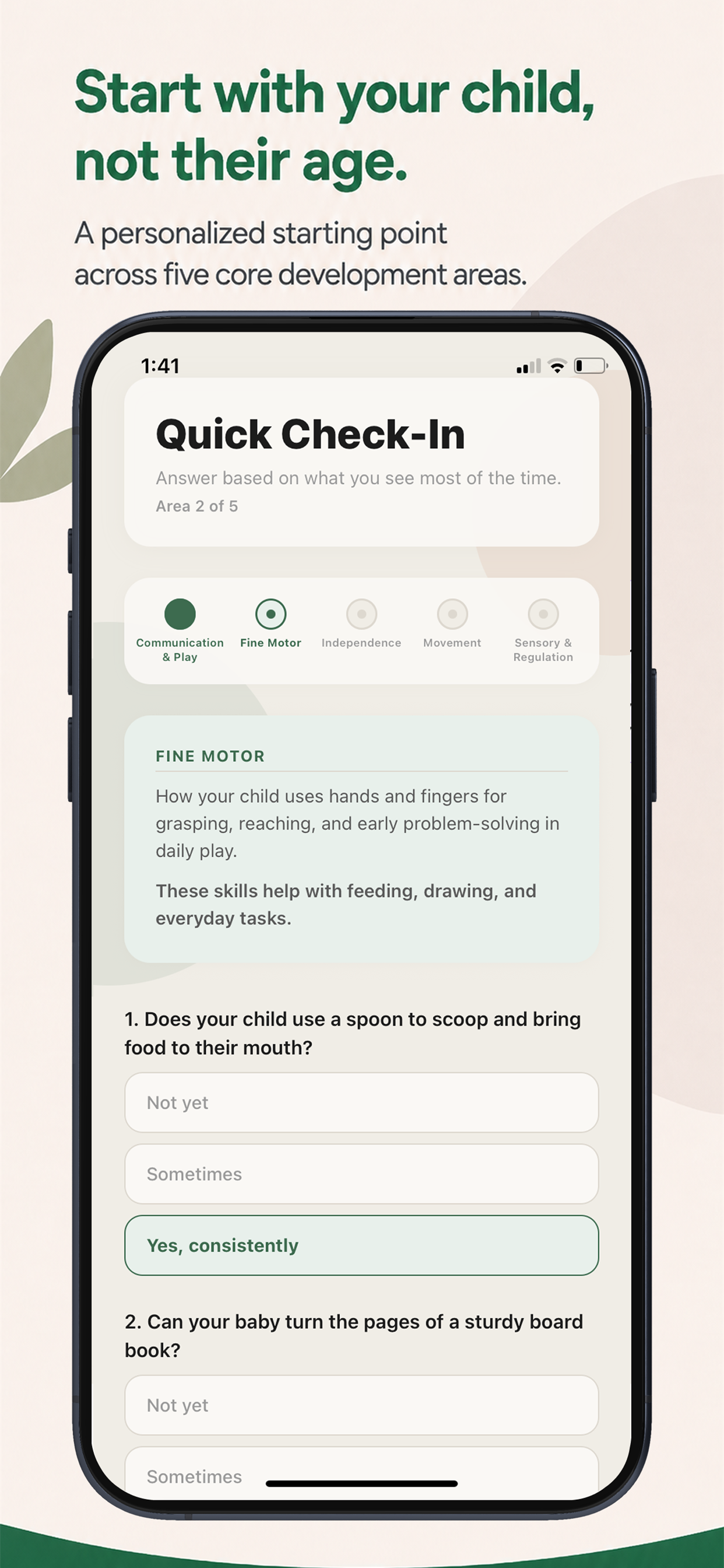
Flourish’s onboarding check-in asks about things you can observe across all five development areas. In Movement, that includes how your child holds and moves their body, changes positions, and gets around.

Your answers help establish a starting point for this area separately from Fine Motor, Communication & Play, Sensory & Regulation, and Independence.

That means you can choose activities for the child you’re actually seeing: confident in some abilities, beginning to explore others, and changing as they go.

Flourish onboarding check-in establishing an individual starting point across five development areas
Flourish app

Turn what you notice into something to try today

Flourish recommends Daily Activities based on your child’s starting point across the five areas.

You get practical instructions and ways to adjust an activity. One-touch feedback helps the app understand how it went, while regular benchmark check-ins capture the abilities you’re seeing develop.

You can also record completed activities, tummy time, and everyday firsts. There’s satisfaction in seeing those moments add up, especially when progress happens in steps that are easy to overlook.

Bekki, a pediatric occupational therapist, mom, and a founder of Flourish, helped shape this approach: understand the child in front of you, offer useful opportunities to practice, and pay attention to what happens next.

Get personalized Daily Activities in Flourish

If your child loses a movement skill they previously had, or something about how they move concerns you, share that observation with their pediatrician.

Sources and further reading